
Last Updated: November 7, 2026
Quick Summary
High quality art is worth it when it delivers lasting enjoyment, personal meaning, and materials that hold up over time, not because it promises a financial return. The 2026 U.S. Art Market Report found artworks held five to ten years returned -0.3% in 2025, essentially flat, so buy art you want to look at for years.
- Stanford research concludes buyers should purchase paintings because they enjoy looking at them, not to make money.
- An unsigned, unnumbered limited print with no stated edition size is a marketing label, not a scarcity claim.
- Fine art prints are worth buying when paper, inks, and printing method are archival and the edition is documented.
- Custom hand-drawn artwork earns its premium when personalization ties the piece to a specific course, race, or place.
- Auction house commissions and gallery fees can erase a thin gain on resale.
Table of Contents
- Is High Quality Art Worth It? The Honest Answer
- Original Art vs Prints: What You Actually Pay For
- What Makes Art Valuable Beyond the Price Tag
- Are Fine Art Prints Worth Buying? Quality Checks That Decide It
- Custom Hand-Drawn Artwork: When Personalization Earns the Premium
- Art as an Investment: What the Evidence Says
- Where to Go From Here
- Frequently Asked Questions
Is High Quality Art Worth It? The Honest Answer
High quality art is worth it when it delivers lasting enjoyment, personal meaning, and materials that hold up over time, not because it promises a financial return.
Two findings frame the whole question. Stanford Graduate School of Business research on art as an investment concludes people should buy paintings because they enjoy looking at them, not to make money. Meanwhile, the 2026 U.S. Art Market Report found artworks held five to ten years effectively maintained their purchase prices in 2025, with a return rate of -0.3%.
So the honest answer splits in two. As an investment, high quality art is a weak bet for most buyers. As a possession you live with daily, it earns its price through craftsmanship, durability, and meaning.
Original Art vs Prints: What You Actually Pay For
Original art is a one-of-a-kind work made by the artist's hand; a print is a reproduction produced in an edition. The price gap reflects labor and scarcity, not decoration value. The useful question is which category fits your goal, budget, and risk tolerance.
A Practical Comparison: Originals, Limited Editions, and Open Editions
Use this comparison to match the category to what you want from the purchase. The figures are relative, not quoted prices, because costs vary widely by artist and market.
| Factor | Original work | Limited edition print | Open edition print |
|---|---|---|---|
| Price | Highest, pays for the artist's time and the fact that only one exists | Moderate, cost per unit falls as the edition size rises, but scarcity keeps a floor under price | Lowest, reproduced at volume, so the unit cost is minimal |
| Uniqueness | One of one; no identical piece exists | Fixed run, often numbered and signed; the edition size is the scarcity | Unlimited; identical copies are produced indefinitely |
| Durability | Depends on the original medium, oil, acrylic, watercolor, and paper each age differently | Archival if printed on cotton rag with pigment inks; cheap stock fades | Highly variable; many open editions use dye inks and thin paper that degrade in normal light |
| Resale potential | Strongest claim to long-term value, but liquidity is thin and buyer-finding is slow | Moderate; signed, low-edition prints from recognized artists can resell, but most do not appreciate | Minimal; open editions rarely hold value because a buyer can order a new copy |
| Best for | Collectors and buyers who value the artist's hand | Buyers who want quality and a degree of scarcity at moderate cost | Decorating on a budget where the image matters more than the object |
Where the Price Difference Comes From
An original painting carries hours of the artist's time and exists once. A fine-art print is reproduced from a master image, so cost per unit drops sharply as edition size rises, which is why a hand-drawn original and an open-edition print of the same image can sit hundreds apart in price.
Watch out: a limited edition is only as valuable as its documentation. An unsigned, unnumbered "limited" print with no stated edition size is a marketing label, not a scarcity claim, ask for the edition size and signature in writing before you pay a premium.
The Total Cost of Ownership
The purchase price is only the first cost. Framing, shipping, insurance, conservation, and resale fees change the real cost of owning quality art.
- Framing: originals often need custom framing, which can rival the cost of a modest print; standard-size prints can use off-the-shelf frames.
- Shipping and insurance: originals are one of one, so shipping insurance is priced against a unique object; prints ship flat or rolled at lower cost.
- Conservation: originals on paper may need UV-filtering glass and acid-free backing; archival prints need the same care to deliver their rated longevity.
Compare total cost, not sticker price.
What Makes Art Valuable Beyond the Price Tag
Art's value beyond price comes from four things: craftsmanship, materials, the artist's reputation, and the personal meaning the piece carries for you. Only the first two are fully within your control.
Craftsmanship, Materials and Artist Reputation
Craftsmanship shows in the details. Clean linework, deliberate composition, and consistent style signal an artist who drew the piece rather than traced it. Materials decide whether the work still looks right in a decade. Archival paper and pigment inks resist fading; cheap stock does not.
Artist reputation adds a market layer. Research published in the European Journal of Cultural Management and Policy on the value of art institutions examines how people perceive the value of art and culture in their communities, and the theme runs through the literature: art's worth is social and personal as much as financial. If you are choosing a piece for a room, our guide to what art makes a modern living room feel sophisticated walks through the selection side.
Are Fine Art Prints Worth Buying? Quality Checks That Decide It
Fine art prints are worth buying when the paper, inks, and printing method are archival and the edition is documented. A print on quality stock outlasts a cheap poster by decades.
Run these checks before you pay:
- Paper stock: ask for the weight and type. Cotton rag or heavy card stock signals intent.
- Ink type: pigment inks resist fading far better than dye-based inks.
- Print longevity: ask how the print is rated for display in normal light.
- Edition size: a numbered, limited run holds more value than an open edition.
- Signature: a signed print carries more collectible weight.
Verifying Print Quality and Authenticity
Authenticity comes down to documentation. A certificate of authenticity should name the artist, the title, the edition size, and the print number. Provenance matters most for limited editions and originals.
Watch out: an unsigned open-edition print sold as "museum quality" with no paper specification is marketing, not a quality claim. If you are buying art as a gift, our roundup of meaningful gifts for golf lovers shows the quality bar to expect.
Custom Hand-Drawn Artwork: When Personalization Earns the Premium
Custom hand-drawn artwork earns its premium when the personalization is the point: a specific course, race, or place that means something to you. You are paying for a drawing made for your memory, not a generic image.
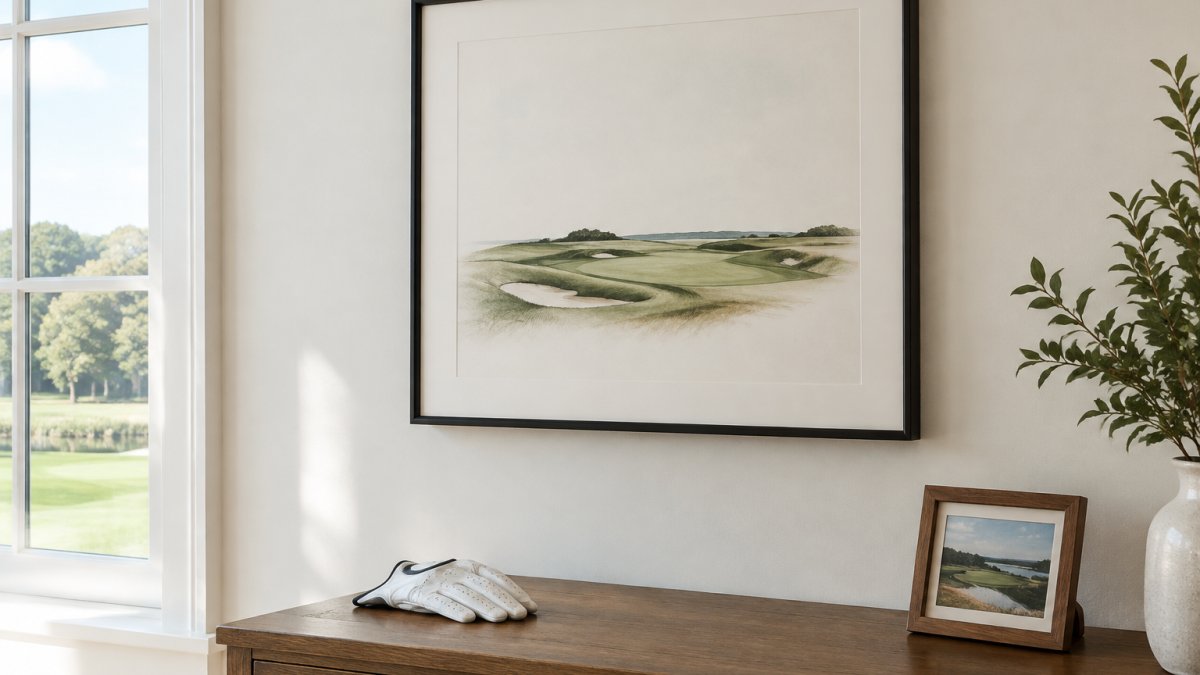
This is where the value argument gets strongest. A mass-produced print of a famous course could hang in anyone's home. A hand-drawn illustration of the course where your father learned to play belongs in yours.
Our personalized artwork for dad birthday gifts shows what a custom piece looks like in practice. If you already know the course you want, the customizable golf course art print lets you choose the size, the number of holes, and the course name and location.

Art as an Investment: What the Evidence Says
Art is a weak investment for most buyers, and the data is blunt about it. Meanwhile, the Art Basel and UBS Global Art Market Report 2026 found fine-art lots sold above $1 million rose 21% in value year over year, with transactions up 15%.
Strength tends to sit at the very top of the market, among buyers with access, expertise, and patience. For everyone else, resale is uncertain once you subtract auction and gallery fees. Investment risk is real, and liquidity is thin.
What Resale Actually Looks Like
The headline return hides the mechanics that decide whether you break even. Resale is a matter of access, timing, and cost.
- Transaction costs: auction houses typically charge a seller's commission plus fees, and galleries take a cut on consignment. A piece that rises modestly in value can still return less than you paid once these are subtracted.
- Holding periods: the five-to-ten-year window in the market report is not a guarantee; it is the period over which the data was measured. Selling sooner usually means accepting a discount.
- Liquidity: finding a buyer for a specific work can take months, and the pool of buyers is narrow outside the top of the market. Works by emerging artists often sit unsold far longer than owners expect.
Setting Realistic Expectations
A simple framework separates enjoyment from investment. If your goal is enjoyment, judge the purchase on quality of life, personal meaning, and emotional enjoyment, the math works because the return is daily.
That does not make high quality art a bad purchase. It makes it a different kind of purchase. Judge it on quality of life, personal meaning, and emotional enjoyment, and the math works.
| Buyer goal | Best fit | What it costs | What you get |
|---|---|---|---|
| Enjoyment and decor | Open or limited edition print | Lowest | The image you love, archival quality |
| Personal meaning | Custom hand-drawn piece | Moderate | A one-off tied to your memory |
| Collection and resale | Original or signed limited edition | Highest | Scarcity, provenance, uncertain return |
Where to Go From Here
The question is not whether art is worth buying. It is what you want the purchase to do. If you want a flat, uncertain financial instrument, look elsewhere.
Our approach centres on hand-drawn, minimalist pieces designed in-house. Start with the course or the race that matters to you, and we will draw it.
The challenge is simple: most art purchases fail not on price but on meaning.
Frequently Asked Questions
Is high quality art worth the extra cost?
It depends on what you want from it. If you want a piece you will look at every day for years, higher quality shows in the paper, the printing and the drawing itself, and those are the things that keep it looking right on your wall. If you only need temporary decor, a cheaper open-edition print does that job. Resale returns on art are uncertain, so treat the extra cost as payment for enjoyment and longevity, not profit.
Is original art worth buying, or are prints just as good?
Originals and prints serve different purposes. An original is a one-off, so its value rests on the artist's reputation and the work's provenance. A print is a reproduction, and its worth depends on print quality, edition size and whether it carries a signature or certificate of authenticity. For most buyers, a well-made limited edition or a custom hand-drawn piece delivers the same daily enjoyment at a fraction of the price. Decide based on whether you want exclusivity or the image itself.
How can you tell if artwork is high quality?
Ask three questions before you buy. What is it printed on, and is the paper archival? What inks were used, and are they pigment-based rather than dye-based? Who made it, and can the seller describe the process? On a custom piece, ask whether the artwork is drawn from scratch for your order. A seller who can answer all three in specific terms is usually selling something that will hold up. Vague answers about 'premium materials' are the warning sign.
What should you consider before commissioning custom artwork?
Start with the details you want captured, such as a specific course layout, a lake shoreline or your race stats, and confirm the artist can work at that level of specificity. Check the production timeline, since custom illustration adds design time before shipping, and ask whether custom work is included in the price or billed separately. Finally, confirm the print size, whether it arrives framed, and the return policy before you pay.
Do high-quality art prints last longer?
They usually do, because the materials are chosen for longevity. Archival paper and pigment inks resist fading far better than standard office paper and dye inks, and heavier cotton stock holds its surface without yellowing. Display conditions matter too: keep prints out of direct sunlight and away from damp walls. A quality print stored and framed sensibly can stay vivid for decades, while a cheap reproduction may visibly shift within a few years.
